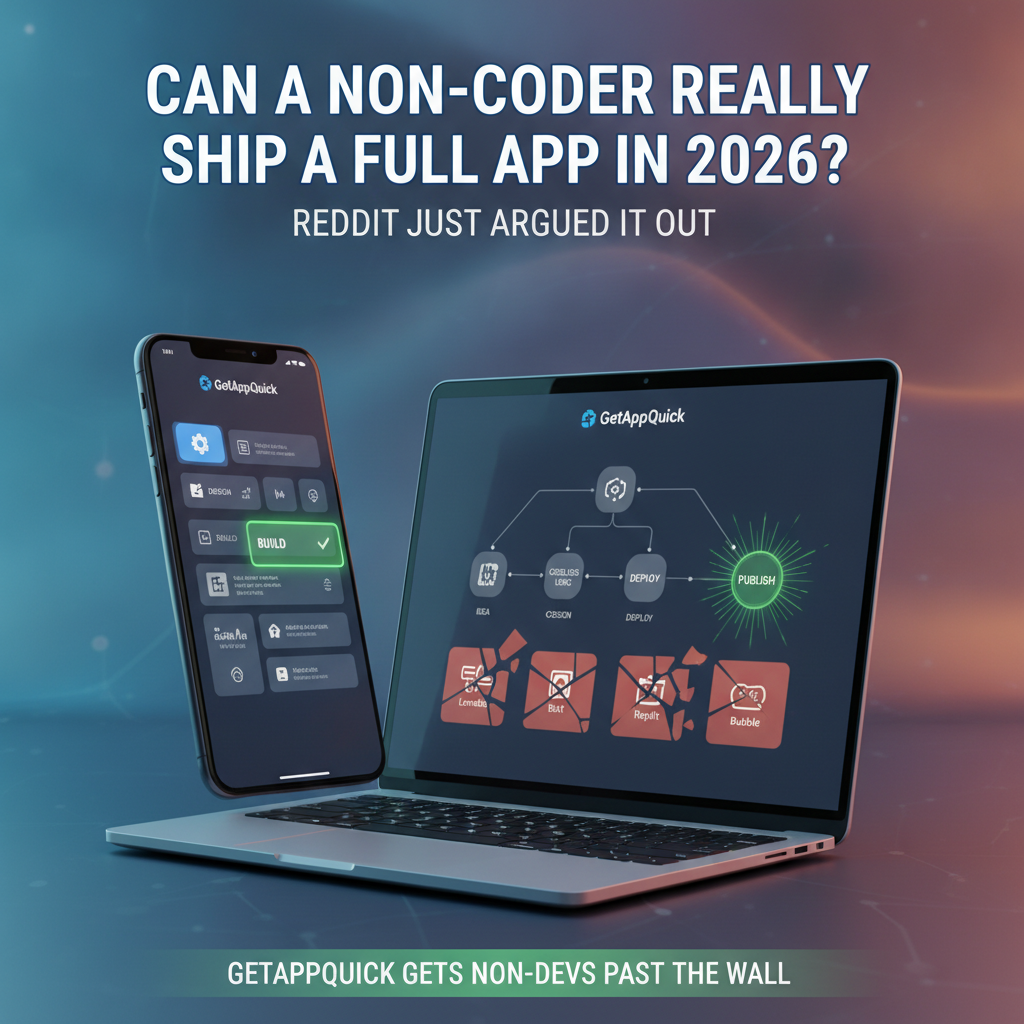
Can a Non-Coder Really Ship a Full App in 2026? Reddit Just Argued It Out
The future of software development is being hotly debated, and nowhere is that clearer than in the passionate discussions happening on Reddit’s r/nocode. As AI, drag-and-drop platforms, and template-driven design keep evolving, the question gets sharper: can someone with literally zero coding skills actually ship a robust, real-world app by 2026? Or have the “no-code” tools we know—Lovable, Bolt, Replit, Bubble—hit a ceiling?
This isn’t just a theoretical debate. For product managers, startup founders, and teams with ambitious ideas but not a dev army, this matters. You want to go from napkin sketch to launch without a decade of Stack Overflow or burning cash on contractors. Today we’ll dig into the main arguments, show where the current platforms stall out, and—crucially—show how GetAppQuick, DC Codes’ own AI-powered builder, is already getting non-coders past the wall.
The Reddit Showdown: Is No-Code Actually “No Code”?
The Lovable-Bolt-Bubble Debate
On r/nocode, one recent thread exploded after a user asked: “If I want to build a full-featured app—user accounts, payments, notifications—what’s actually possible without code?” Replies flooded in. Fans of Lovable and Bubble posted impressive dashboards, but a deeper look revealed caveats:
- Templates are great, but break easily. Once you want to change a field, add logic, or connect to a third-party API—suddenly you’re pasting JavaScript or wrestling with constraints.
- Bolt and Replit can handle more logic, but require scripting. “No code” turns into “some code,” and the learning curve spikes.
- Performance and flexibility hit a wall. Users reported trouble scaling, optimizing, or integrating features that fall outside the platform’s sandbox.
Example complaints:
“Bubble’s logic is visual, but try to build a custom chat or real-time update—good luck unless you’re a dev.”
“Lovable’s templates work until you want to change the user flow. Then you hit a ‘write code here’ block.”
What “No Code” Can Really Do in 2024 (and What It Can’t)
Let’s get specific. Here’s what you can (and can’t) do out-of-the-box with the popular platforms:
| Platform | Great For | Stumbles On |
|---|---|---|
| Lovable | Landing pages, simple CRM | Custom logic, deep integrations |
| Bolt | Flows, automation | Rich UI, API extensibility |
| Replit | Fast prototyping, simple tools | Mobile UIs, scaling |
| Bubble | CRUD apps, MVPs | Real-time, performance |
It’s not that these tools are bad—they are incredible for launching simple MVPs or internal tools. But when you want:
- Custom onboarding flows
- Real-time chat or feeds
- Seamless mobile and web versions
- Sophisticated data modeling and logic
You’re soon staring at a code editor or hiring help. That’s the “wall” the Redditors keep hitting.
The Wall: Where No-Code Platforms Stall Out
Why “No-Code” Isn’t the Whole Solution
So what happens when you try to move past basic prototypes?
- Complex Logic: Want to implement a recommendation engine, conditional notifications, or complex data relationships? You hit visual workflow limits.
- Custom Integrations: Need to connect to a SaaS API, or trigger an action in response to a webhook? Unless there’s a prebuilt module, you’re in code territory.
- UI/UX Precision: “Pixel-perfect” mobile apps, or matching your brand’s exact flow, become a battle of workarounds.
- Performance & Security: As your user base grows, platforms like Bubble or Lovable can’t always keep up, and you can’t tune the backend.
Example: Where Code Sneaks Back In
Suppose you need to add a dynamic badge to a user profile in a Bubble app, based on complex engagement logic. You’re forced to use Bubble’s “backend workflow” system—essentially scripting in their visual DSL. It might look like this pseudo-code:
// Bubble Custom Backend Workflow (pseudo)
if (user.engagementScore > 500 && !user.hasBadge("PowerUser")) {
  user.addBadge("PowerUser")
}
Except in reality, you’re wiring up logic blocks, and debugging gets ugly fast.
The 2026 Leap: How AI is Redefining App Building
The Next Step: AI That Actually Gets Your Idea
Recent advances mean true “no-code” isn’t about dragging blocks—it’s about describing what you want, and letting AI handle the scaffolding, logic, and integrations. Instead of wrestling with templates, you describe your business logic, user types, and flows in plain language.
That’s where GetAppQuick comes in. Unlike drag-and-drop builders, it fuses AI reasoning with robust underlying frameworks (think: Flutter for cross-platform apps, Node.js/TypeScript for APIs). You sketch your idea, and GetAppQuick generates real, production-ready code—no dead-ends, no handoffs to developers.

Practical Example: Building a Loyalty Rewards App
Let’s say you want to launch a “coffee shop loyalty app”:
- Users earn points for purchases
- Redeem points for rewards
- Admin dashboard to add or remove offers
- Push notifications for new deals
Here’s how you’d do it the hard way (Bubble or Bolt):
- Stitch together templates for login, rewards, and redeem flows
- Hack together complex “workflows” to track points
- Hit limits when connecting external payment APIs
With GetAppQuick, you simply describe:
“I need a mobile app where users scan a QR code after purchases, earn points, and redeem for rewards. Admins can update offers and send push notifications.”
GetAppQuick generates:
- Flutter code for cross-platform mobile app
- Secure API backend (Node.js/TypeScript)
- Admin portal
- Authentication, user roles, and real-time notifications
Sample: Dart/Flutter Widget for Rewards List
Here’s what a rewards list widget might look like under the hood—auto-generated, but fully editable if you ever want to customize:
class RewardsList extends StatelessWidget {
  final List<Reward> rewards;

  RewardsList({required this.rewards});

  @override
  Widget build(BuildContext context) {
    return ListView.builder(
      itemCount: rewards.length,
      itemBuilder: (context, index) {
        final reward = rewards[index];
        return Card(
          child: ListTile(
            title: Text(reward.title),
            subtitle: Text('${reward.pointsRequired} points'),
            trailing: ElevatedButton(
              onPressed: reward.isAvailable
                  ? () => redeemReward(reward)
                  : null,
              child: Text('Redeem'),
            ),
          ),
        );
      },
    );
  }

  void redeemReward(Reward reward) {
    // Call to backend API to redeem
  }
}
You don’t see this code unless you want to—it’s generated by the AI, not by you. But the crucial bit: there’s no “wall” between you and production-grade code, if you ever want to customize or scale.
Real-World Use Case: Launching Without a Dev Team
A Non-Developer’s Journey
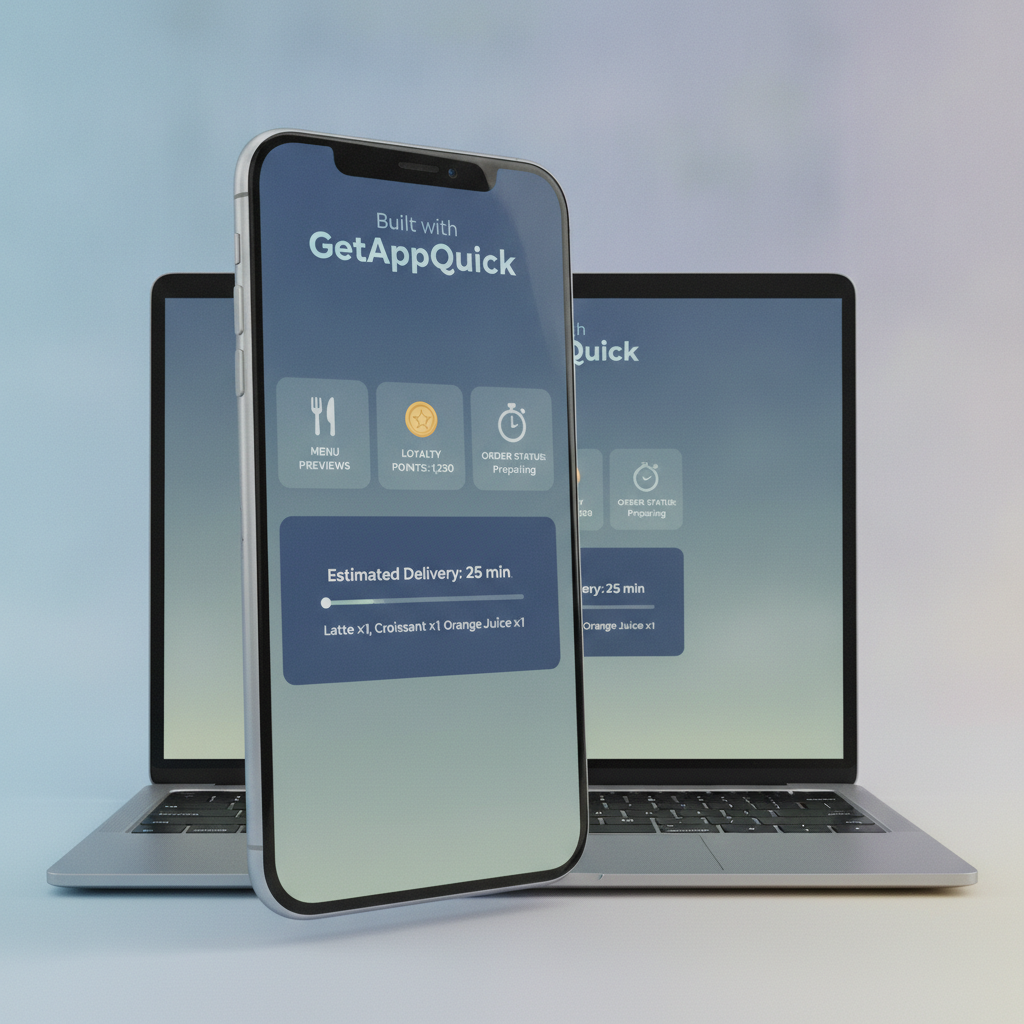
Let’s profile “Mai,” a marketing manager at a Vietnamese F&B startup. Her team wants an app to:
- Showcase daily menus
- Let users pre-order
- Handle basic loyalty points
Mai isn’t a coder, and her budget won’t cover a dev team. She tries Bubble and Bolt. She quickly gets stuck on:
- Custom mobile UI—she needs Vietnamese language support, dark mode, and animated menu transitions
- Integrating with her payment provider, who only offers a REST API
She turns to GetAppQuick. In the onboarding flow, she describes her app requirements in Vietnamese—GetAppQuick’s AI understands, scaffolds the entire user flow, and generates the Flutter app instantly.
- Result: Within days, her startup launches a sleek, branded app—no code, no outsourcing.
- Bonus: As her business grows, she can hand the codebase to developers to expand features, with no need to “rebuild” from scratch.
The New Paradigm: “No-Code” Meets Real Code, Powered by AI
What Sets Next-Gen Platforms Apart?
- Idea-to-App in Minutes: Platforms like GetAppQuick let you sketch your vision, choose features, and deploy—no “template wrangling.”
- Multi-Platform by Default: Flutter and web deployment, API backend, all handled under the hood.
- Genuine Extensibility: You’re never trapped. When you need a developer, they get clean, documented code—not a walled garden.
- AI-Generated, Human-Readable: The underlying Dart/TypeScript code is ready for handoff, maintenance, or advanced customization.
Comparison Table
| Feature | Bolt | Bubble | Lovable | GetAppQuick |
|---|---|---|---|---|
| Custom Logic | Limited | Visual scripting | Very limited | Full AI-generated, editable code |
| Mobile & Web Apps | Web only | Web only | Web only | Flutter mobile & web |
| API Integrations | Prebuilt only | Some via plugins | Limited | Any API, described in plain language |
| Open Code Export | No | No | No | Yes |
| AI-Driven Build | No | No | No | Yes |
Key Takeaways
- No-code tools have democratized prototyping, but most hit a wall when projects need real logic, integrations, or scale.
- 2026’s real game-changer is AI-powered platforms that turn plain ideas into robust, production-ready apps—no template hacks required.
- GetAppQuick lets non-coders ship cross-platform, real-world apps, with the power to scale, extend, and hand off to developers when needed.
- The ability to generate, export, and customize real code (Dart, TypeScript) means you’re never trapped or limited.
- Whether you’re launching a side project, MVP, or internal tool, the “no-code wall” is coming down.
Conclusion: The App Revolution Is Here. Will You Act?
The Reddit debates make one thing clear: the old “no-code” model empowered millions, but left them stranded at the edge of real innovation. AI-powered builders like GetAppQuick are bridging that gap—letting non-coders ship, scale, and own their creations, with no handoffs or technical ceilings.
Ready to ship your idea? Build it in minutes with GetAppQuick.