
Agentic AI is Automating App Workflows: Are You Ready for the Next Level?
Understand the cutting-edge trend of agentic AI and workflow automation, exemplified by platforms like Lindy and Zapier, and how these intelligent agents are poised to revolutionize how we build and manage applications.
The software development landscape is in constant flux, with new technologies and methodologies emerging at an unprecedented pace. For years, we've seen automation tools streamline repetitive tasks, allowing developers to focus on more complex challenges. However, we're now on the cusp of a new era, one powered by "agentic AI." This isn't just about automating simple tasks; it's about intelligent agents that can understand context, make decisions, and execute complex workflows with minimal human intervention. Platforms like Lindy and Zapier are leading the charge, demonstrating how these sophisticated AI agents are set to fundamentally change how we conceive, build, and manage applications. For those looking to bring their app ideas to life quickly and efficiently, tools like GetAppQuick are already harnessing this power, transforming a plain idea into a working app with remarkable speed.
The Rise of Agentic AI: More Than Just Automation
At its core, agentic AI refers to artificial intelligence systems designed to act autonomously in an environment to achieve specific goals. Unlike traditional automation scripts that follow rigid predefined rules, agentic AI possesses a degree of intelligence that allows it to:
- Perceive: Understand its environment and the data it receives.
- Reason: Analyze information, identify patterns, and make logical deductions.
- Plan: Formulate a sequence of actions to achieve a desired outcome.
- Act: Execute those actions, often iteratively, refining its approach based on feedback.
This self-directed learning and problem-solving capability is what sets agentic AI apart. It moves beyond simply executing a command to understanding the intent behind it and adapting to achieve the goal.
From Simple Scripts to Intelligent Agents
Consider the evolution of workflow automation. Initially, tools like cron jobs or simple scripting languages were used for tasks like batch processing or data backups. Then came platforms like Zapier and IFTTT, which allowed users to connect different web applications and automate "if this, then that" scenarios without extensive coding. These tools were revolutionary, democratizing automation.

However, agentic AI takes this a significant step further. Instead of a human defining every single step and condition, an agentic AI can:
- Interpret complex requests: A user might say, "Draft a marketing email to our recent customers about the new feature, segmenting by those who have used it more than three times." An agentic AI can break this down into sub-tasks: identify recent customers, check feature usage, compose an email with appropriate tone, and schedule delivery.
- Learn and adapt: If a certain email subject line yields a low open rate, the AI can learn from this and adjust future subject lines.
- Handle exceptions: If an API call fails, the agent can attempt a retry or log an error for human review, rather than simply halting the process.
- Collaborate: Imagine AI agents working together, one gathering data, another analyzing it, and a third generating a report.
The implications for application development and management are profound. We're moving from a model where developers meticulously build every component to one where AI assists in designing, coding, testing, and even deploying applications.
Agentic AI in Action: Transforming App Workflows
The potential applications of agentic AI in the app development lifecycle are vast. Let's explore some key areas:
1. Intelligent Code Generation and Refinement
Tools are emerging that can generate code snippets or even entire functions based on natural language descriptions. While not yet at the level of fully autonomous app creation for complex projects, these agents can significantly accelerate development.
Consider a scenario where you need to implement a user authentication flow. Instead of writing all the boilerplate code, you might prompt an agentic AI with something like: "Create a secure user registration and login module using Firebase authentication, including email verification and password reset functionality."
Here's a simplified example of how such an agent might approach generating TypeScript code for a login function:
// Agentic AI generated code for a login function
import { auth, signInWithEmailAndPassword } from './firebase-config'; // Assuming firebase-config is set up

async function loginUser(email: string, password: string): Promise<User | null> {
  try {
    const userCredential = await signInWithEmailAndPassword(auth, email, password);
    const user = userCredential.user;
    console.log('User logged in successfully:', user.email);
    return user;
  } catch (error) {
    console.error('Error logging in user:', error.code, error.message);
    // Agent might decide to handle specific error codes, e.g., wrong password vs user not found
    if (error.code === 'auth/user-not-found') {
      console.warn('User account does not exist.');
    } else if (error.code === 'auth/wrong-password') {
      console.warn('Incorrect password provided.');
    }
    return null;
  }
}

// Example usage:
// loginUser('test@example.com', 'password123')
//   .then(user => {
//     if (user) {
//       // Navigate to dashboard or other authenticated view
//     } else {
//       // Show error message to user
//     }
//   });
An agentic AI wouldn't just provide the code; it might also suggest best practices, potential security vulnerabilities, or even generate unit tests to verify the functionality.
2. Automated Testing and Debugging
Testing is a critical but often time-consuming part of app development. Agentic AI can revolutionize this by:
- Generating test cases: Based on application requirements or code analysis, AI can create comprehensive test suites covering various scenarios, including edge cases.
- Automated debugging: When bugs are detected, AI can analyze logs, trace execution paths, and even propose code fixes. Platforms are emerging that integrate AI into the debugging process, identifying the root cause of errors far faster than manual inspection.
- Performance monitoring and optimization: AI agents can continuously monitor application performance in production, identify bottlenecks, and suggest or even implement optimizations.
3. Workflow Orchestration and Integration
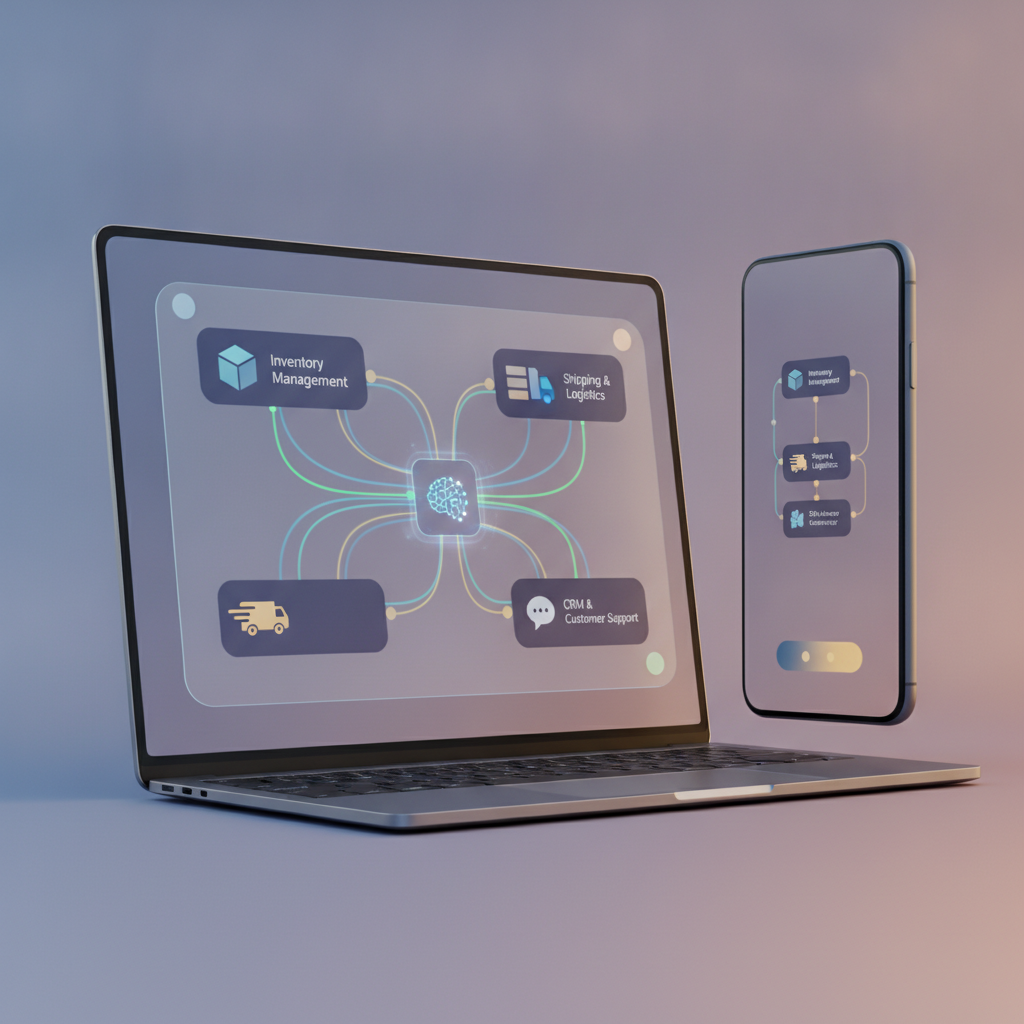
This is where platforms like Lindy and Zapier truly shine, and where agentic AI elevates their capabilities. Instead of just connecting two apps, agentic AI can orchestrate complex multi-step workflows across dozens of services.
Imagine an e-commerce app. An agentic AI could manage the entire post-purchase workflow:
- Order Received: Triggered when a new order is placed.
- Inventory Check: Connect to the inventory management system. If stock is low, notify the purchasing department and flag the order.
- Payment Processing: Verify payment with the payment gateway.
- Shipping Label Generation: Integrate with a shipping provider API (e.g., FedEx, UPS) to generate a label based on customer address and order details.
- Customer Notification: Send a confirmation email to the customer with tracking information.
- CRM Update: Log the order details and customer interaction in the CRM.
- Sales Reporting: Update sales dashboards and analytics.
If any step fails, the agent can intelligently handle it – perhaps by retrying, escalating to a human support agent via a Slack notification, or automatically issuing a refund if an item is out of stock and cannot be procured.
4. Proactive Maintenance and Operations
Beyond development, agentic AI can be deployed to manage deployed applications. This includes:
- Predictive Maintenance: Analyzing server logs and performance metrics to predict potential hardware failures or software issues before they occur.
- Automated Scaling: Dynamically adjusting server resources based on real-time traffic demands.
- Security Monitoring: Constantly scanning for security threats, vulnerabilities, and anomalous activity, and automatically implementing countermeasures.
Practical Implementation: Bridging the Gap
The promise of agentic AI is exciting, but how do we practically leverage it today?
Leveraging No-Code/Low-Code Platforms
For many individuals and businesses, the fastest way to tap into the power of agentic AI for application development is through advanced no-code/low-code platforms. These platforms abstract away much of the underlying complexity, allowing users to define workflows and functionalities using visual interfaces, natural language prompts, or simplified configurations.
GetAppQuick exemplifies this trend. It's designed to turn a simple app idea into a functional application rapidly, leveraging AI to handle much of the coding and integration work. For instance, if you have an idea for a task management app with team collaboration features, GetAppQuick can interpret your requirements and automatically generate the core structure, user interface, and backend logic, allowing you to focus on refining the user experience and specific features.
Integrating AI Agents into Existing Workflows
For more established development teams, integrating agentic AI might involve adopting AI-powered tools for specific parts of the development lifecycle. This could mean:
- AI-assisted coding tools: IDE plugins that offer intelligent code completion, bug detection, and code generation (e.g., GitHub Copilot, Amazon CodeWhisperer).
- Workflow automation platforms with AI capabilities: Tools that go beyond simple triggers and actions to offer intelligent decision-making within automated processes.
- Custom AI agent development: For highly specialized needs, developing custom AI agents using frameworks like LangChain or OpenAI's API allows for tailored solutions.
Here's a snippet demonstrating how you might use Dart/Flutter with an AI service API to trigger a workflow:
// Example using Dart/Flutter to trigger an AI agent for a workflow
import 'package:http/http.dart' as http;
import 'dart:convert';

Future<Map<String, dynamic>> triggerAiWorkflow(String prompt, Map<String, dynamic> data) async {
  final String apiKey = 'YOUR_AI_API_KEY'; // Replace with your actual API key
  final String apiUrl = 'https://api.example-ai-provider.com/v1/workflows/execute'; // Replace with actual API endpoint

  try {
    final response = await http.post(
      Uri.parse(apiUrl),
      headers: {
        'Content-Type': 'application/json',
        'Authorization': 'Bearer $apiKey',
      },
      body: jsonEncode({
        'prompt': prompt,
        'input_data': data,
      }),
    );

    if (response.statusCode == 200) {
      return jsonDecode(response.body);
    } else {
      print('Failed to trigger AI workflow. Status code: ${response.statusCode}');
      print('Response body: ${response.body}');
      throw Exception('AI workflow execution failed');
    }
  } catch (e) {
    print('Error calling AI workflow API: $e');
    throw Exception('Error communicating with AI service');
  }
}

// Example usage in a Flutter app:
// void handleNewOrder(OrderDetails order) async {
//   final String workflowPrompt = "Process new e-commerce order";
//   final Map<String, dynamic> inputData = {
//     'order_id': order.id,
//     'customer_email': order.email,
//     'items': order.items.map((item) => {'sku': item.sku, 'quantity': item.quantity}).toList(),
//     'shipping_address': order.address.toJson(),
//   };
//
//   try {
//     final result = await triggerAiWorkflow(workflowPrompt, inputData);
//     print('AI workflow completed: $result');
//     // Handle workflow completion, e.g., update UI, send confirmation
//   } catch (e) {
//     // Handle errors, e.g., show an error message to the user
//   }
// }
This example shows how a mobile app could initiate a complex, AI-driven backend process with a simple function call, passing necessary data and a descriptive prompt.
Key Takeaways
- Agentic AI is here: This isn't science fiction; intelligent agents capable of perception, reasoning, planning, and action are already a reality.
- Beyond simple automation: Agentic AI moves past fixed rules to dynamic, context-aware task execution.
- Revolutionizing App Dev: From code generation and testing to complex workflow orchestration, AI agents are set to transform the entire application lifecycle.
- Accessibility is growing: Tools like Lindy, Zapier, and no-code platforms such as GetAppQuick are making these powerful capabilities accessible to a wider audience.
- The future is collaborative: Expect a future where human developers and AI agents work in tandem, accelerating innovation and efficiency.
Are You Ready for the Next Level?
The integration of agentic AI into app development and workflow automation represents a significant leap forward. It promises to make application creation more accessible, efficient, and intelligent than ever before. While the full potential is still unfolding, the trend is clear: autonomous intelligent agents are becoming integral to how we build and manage software. Embracing these advancements now will position you and your organization at the forefront of innovation.
Ready to ship your idea? Build it in minutes with GetAppQuick.